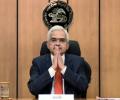
'Even if there is a third wave or a fourth wave, it is hard to see the economy will suffer like that (during the first wave).'

'We have delivered a bitter medicine. It will take time to work.'

Reserve Bank of India (RBI) Governor Raghuram Rajan's decision to cut rates last week surprised even top officials.
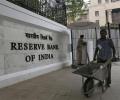
Key risk for price rise is the 'deficient' monsoon that could lead to a pick-up in inflation expectations.

Governments that do not respect central banks' independence will sooner or later incur the wrath of the financial markets, ignite economic fires, and come to rue the day they undermined an important regulatory institution; their wiser counterparts who invest in central bank independence will enjoy lower costs of borrowing, the love of international investors, and longer life spans, said Acharya, who will return to the New York University's Stern Business School in August.
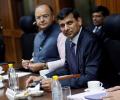
Balance is needed in selecting members for the proposed monetary policy committee, says Abheek Barua.

'Rate cut should reiterate RBI's commitment in providing confidence to consumers and small business.'
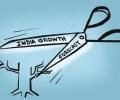
The biggest risk to India's growth outlook is an escalation of geopolitical tensions, especially if these tensions spread to the Asian region, RBI Monetary Policy Committee (MPC) member Jayanth R Varma said on Wednesday. Varma, in an interview to PTI, said that inflation and inflationary expectations appear to be moderating and high inflation will certainly not become the 'norm' in the country. He is cautiously optimistic about the Indian economy as after the pandemic abated, consumption demand has begun to recover though the recovery is uneven across sectors and industries.

Market breadth depicted gains with 1,476 advances over 1,403 declines on the BSE. 140 stocks remained unchanged.
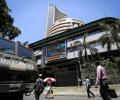
Bank Nifty pared all its intraday gains to end over 1% lower led by losses in BoB, ICICI Bank, Axis Bank and Bank of India

The finance ministry on Thursday raised concerns over the possible impact of El Nio conditions on India this year, saying if recent forecasts came true, the country could see lower agricultural output and higher inflation. "Some meteorological agencies predict the return of El Nio conditions in India this year. "If these predictions are accurate, then monsoon rains could be deficient, leading to lower agricultural output and higher prices," the ministry said in its monthly economic review.

Volatility is likely to continue in the stock market this week amid Omicron uncertainty and the RBI monetary policy meeting will be a key driver for benchmark indices going ahead, say analysts. It will be an event-packed week for the markets, with RBI policy and several macroeconomic numbers scheduled to be announced, they added. "Volatility is likely to continue amid Omicron uncertainty, RBI credit policy, and macroeconomic numbers. "There are lots of news flows on the Omicron variant which are causing volatility in the market while on the domestic front we will have the outcome of an important monetary policy of RBI that is scheduled on December 8. "We will also have our IIP and inflation numbers this week however they will be released on Friday after market hours," said Santosh Meena, Head of Research, Swastika Investmart Ltd.

The first task before him is to get used to the idea of working with the Monetary Policy Committee

India's services sector growth eased to a three-month low in June but service providers continued to signal positive demand trends, which resulted in a stronger increase in new business volumes and further job creation, a monthly survey said on Wednesday. The seasonally adjusted S&P Global India Services PMI Business Activity Index fell from 61.2 in May to 58.5 in June. Despite falling from May, the latest figure was consistent with a sharp pace of growth.

Bajaj Finance was the top gainer in the Sensex pack, rising around 4 per cent, followed by Maruti, SBI, Bajaj Finserv, Sun Pharma and Asian Paints. NSE Nifty rallied 293.05 points to 17,469.75.
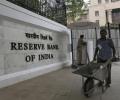
It further pointed out that the twin balance sheet problem -- at the end of banks and corporate -- more attractive interest rates for borrowers in the bond market and from non-banking financial institutions are other reasons for slow bank credit growth.
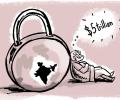
The wait for India to become a $5-trillion economic powerhouse by 2024-25 (FY25) is going to take longer than what the finance ministry had originally intended, according to the International Monetary Fund (IMF). The vision will instead be achieved in 2028-29 (FY29), reveals the IMF data, illustrating a four-year delay. Chief Economic Advisor (CEA) V Anantha Nageswaran had in February said India would become a $5-trillion economy by 2025-26 or the following year, on the back of 8-9 per cent sustained growth rate in real gross domestic product (GDP). However, the IMF data conveys that the economy will be $4.92 trillion in FY28, clearly alluding to the fact that the target will be realised in FY29.

The International Monetary Fund (IMF) on Tuesday slashed India's growth forecast for 2022-23 (FY23) by 80 basis points to 7.4 per cent, citing less favourable external conditions and rapid policy tightening by the central bank. In its update to the April World Economic Outlook, the IMF said that though a global recession in 2022 was ruled out with a growth estimate of 3.2 per cent, the balance of risks was squarely to the downside, driven by a wide range of factors that could adversely affect the global economic performance. "The risk of recession is particularly prominent in 2023, when in several economies growth is expected to bottom out, household savings accumulated during the pandemic will have declined, and even small shocks could cause economies to stall.

There is a narrow chance that the central bank may cut rates in the future, according to a poll of 15 economists and treasurers.
By no means do economists see the Reserve Bank of India stop at just a 25-bp cut. Some of the economists such as Soumyakanti Ghosh of State Bank of India are of the firm view that rates have room to fall by a total of 75 bps in the current financial year, starting with 25 bps in the August 7 policy.

The increase reflects a quarter-on-quarter increase of 2.6 per cent in October-December 2022-23. In absolute terms, the total liabilities, including liabilities under the 'Public Account' of the government, jumped to Rs 1,50,95,970.8 crore at the end of December 2022.

'We are very watchful about inflation and growth. But the main challenge is economic revival and growth.'

The report, however, said it remains watchful of the upside risks to inflation emanating from pass-through of minimum support prices (MSPs), adverse movement in crude oil prices, volatility in global financial markets, lagged impact of the rupee weakness on input prices, adverse implications from fiscal slippage and staggered impact of HRA increases by states and its second-round impact.

In a double delight, retail inflation eased to a one-year low of 5.72 per cent - staying below the upper tolerance limit for two months in a row, while factory output rose sharply to 7.2 per cent on the back of healthy growth in manufacturing. The retail inflation numbers based on Consumer Price Index (CPI) will provide some room for the Reserve Bank to further moderate the quantum of hike in key interest rate or even press a pause button. The RBI has been on a rate hiking spree since May 2022 in its bid to tame inflation, having raised the repo rate by a cumulative 225 basis points (bps).

Inflation in the 'fuel and power' basket in December slumped to 8.38 per cent, nearly half of 16.28 per cent.
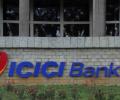
Private sector lender ICICI Bank has revised its external benchmark lending rate (EBLR) to 8.10 per cent, and state-owned Bank of Baroda has raised the rate to 6.90 per cent with immediate effect after the RBI hiked the key repo rate. Likewise, two other public sector banks -- Bank of India and Central Bank of India -- have also raised the repo linked lending rate. In an out of turn Monetary Committee Meeting (MPC), the Reserve Bank on Wednesday announced to hike the benchmark repo rate -- the short term lending rate it charges to banks -- by 0.40 per cent to 4.40 per cent with immediate effect, aimed at taming the rising inflation caused by the global geopolitical situation.

Heavy dollar selling by banks and exporters alongside debt-related inflows largely supported the rupee

Manufacturing activities in India touched a three-month high in March boosted by faster expansions in new orders and output amid demand resilience and easing of cost pressures, according to a monthly survey. The seasonally adjusted S&P Global India Manufacturing Purchasing Managers' Index (PMI) rose from 55.3 in February to 56.4 in March, signalling the strongest improvement in operating conditions in 2023 so far. The March PMI data pointed to an improvement in overall operating conditions for the 21st straight month.
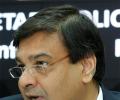
Chetan Ghate, Pami Dua and Ravindra Dholakia have been appointed for 4 years

Reserve Bank of India Governor Urjit Patel on Saturday exhorted banks to reduce their lending rates to push credit demand in laggard segments, saying banks have benefited from influx of low-cost deposits and its previous repo rate cuts.

Rising crude oil prices, traction in China equities and inflation concerns back home are casting a shadow on the Indian equity markets in the short term, believe analysts at Jefferies. They said this could see the markets remaining range-bound in the near term before the next leg up.

In twin blows to Indian economic revival, higher food prices drove retail inflation to a five-month high of 7.4 per cent while factory output fell for the first time in 18 months. The second consecutive month of rise in consumer price index (CPI)-based inflation will add to the pressure on the Reserve Bank of India (RBI) to again raise interest rates to tame high prices. Inflation has been above the targeted zone for the ninth month in a row and as per statute, the RBI will now have to explain to the government in writing why it failed to keep prices below 6 per cent.

RBI Governor Shaktikanta Das said that early containment of the pandemic could impart an "upside" to the economic growth outlook.
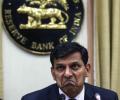
Will RBI chief have the final say, in the form of a veto

Services sector activities improved further and touched a five-month high in April driven by a surge in incoming new work orders that boosted business activity and supported a renewed increase in employment, according to a survey. The seasonally adjusted S&P Global India Services PMI Business Activity Index jumped to 57.9 in April, from 53.6 in March, highlighting a sharp rate of expansion that was the fastest since last November amid mounting price pressures. For the ninth straight month, the services sector witnessed an expansion in output.

Rajan tells RBI colleagues he will be returning to academics

'Normally, the system is geared towards counting notes -- it is equipped to do x amount of work and one day you are asking them to do 20 x.' 'The processes involved are very complex.'

The monetary authority said it was worried on three fronts with regard to inflation as well as the economy.
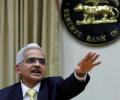
Probably in August. We can argue whether RBI is dovishly neutral or neutrally dovish but the telltale signs of at least one more rate cut are strewn all over the policy statement, points out Tamal Bandyopadhyay.

Investors saw their wealth rise by more than Rs 3.96 lakh crore on Wednesday as stocks continued their rally for the second straight session amid the Reserve Bank reiterating its accommodative stance and easing concerns over the Omicron variant of the coronavirus. The 30-share Sensex soared 1,016.03 points or 1.76 per cent to close at 58,649.68 and all the constituent stocks, except for two, closed in the green. Most of the rate-sensitive auto, banking and realty stocks registered gains during the day's trade. While the BSE Auto index rose 2.24 per cent, BSE Bankex went up 1.61 per cent and BSE Realty spurted 1.72 per cent.
 © 2026 Rediff.com - Advertise with us - Disclaimer - Privacy Policy - Sitemap - Feedback - About us - Terms of use - Grievances